01
Shade bands as numbers
Express an approved shade as a measured standard with a tolerance, so the dyehouse, the mill and the buyer are working from the same definition of acceptable.
Textiles & fibres
Improve shade consistency across fabric, yarn and finished goods, quantify color under textile-standard lighting, and settle shade bands between dyehouse, mill and buyer with measured numbers.
Why shade drifts
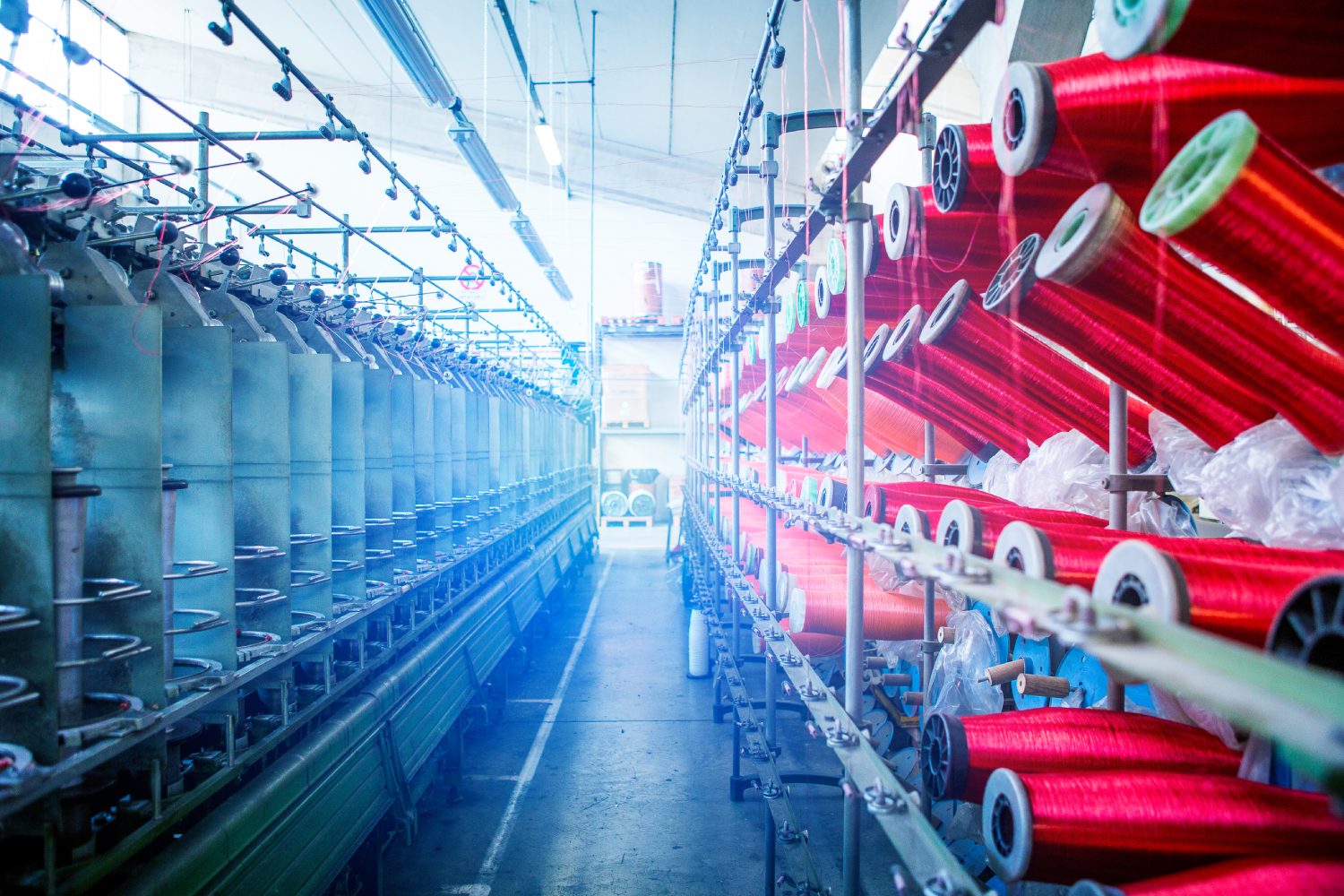
Fibre lots, dye absorption, bath exhaustion, yarn twist and finishing all move the shade of a dye lot. Knitted and woven fabric presents that shade differently again, because a textured or pile surface scatters light depending on how the sample is folded and which way the grain runs. Visual shade matching catches the obvious misses, but it depends on the light in the room and the eye making the call. Measured color under controlled illumination turns the shade band into a specification.
Express an approved shade as a measured standard with a tolerance, so the dyehouse, the mill and the buyer are working from the same definition of acceptable.
Optical brightening agents only respond when UV is present in the light source, so a measurement without it reports a color that no customer ever sees.
Switchable 8 mm and 4 mm apertures with camera-assisted positioning let you measure yarn packages, narrow trims and small swatches.
Instrument options
Choose a portable instrument for production, incoming and on-site checks, or a benchtop instrument for controlled laboratory presentation and repeatable quality assurance. The SD-700 featured below is one relevant portable option—not the full range.
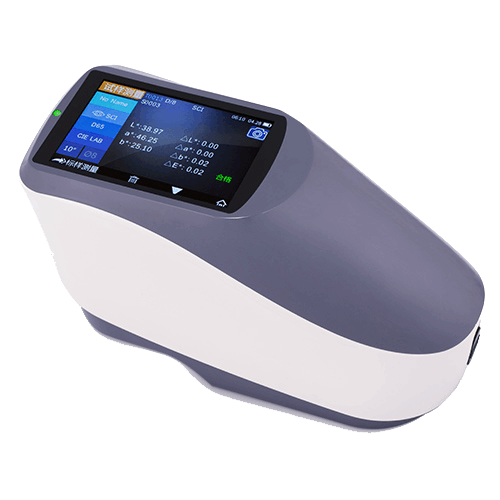
Portable UV grating spectrophotometer
US$5,000
d/8° geometry with switchable SCI/SCE, UV-inclusive 400–700 nm spectral measurement and camera-assisted positioning — built for shade band approval, dye lot release and incoming fabric checks.
Where it pays off
The same standard follows the shade from dyestuff intake to finished goods, so every team measures against the same target.
Approve lab dips against the reference standard, then release production dye lots on the same measured target.
Check delivered fabric and yarn against the approved shade band before it enters cutting or knitting.
Measure whites and pale shades with the UV component included, so the reading matches the appearance under retail lighting.
One instrument model across dyehouses, mills and suppliers means a standard approved in one place reads the same in another.
Keep panels, trims and accessories matched within a garment and between garments in the same order.
Sort rolls into shade groups objectively, and follow color change through laundering, light exposure and finishing tests.
Method notes
Sample presentation affects a textile reading more than it does a flat panel, so method discipline matters as much as the instrument.
| Decision | Common starting point | Why it matters |
|---|---|---|
| Sample preparation | Several layers to opacity, or a blackout backing | Thin or loose fabric transmits light, and the color behind the sample changes the reading unless the sample is made opaque. |
| Folding & grain | One agreed presentation per material | Folding, pile direction, nap and the woven grain all change how light leaves the surface, so the method has to be fixed and followed. |
| Illumination | UV included for whites and pastels | Optical brighteners are common in textiles, and a reading taken without UV reports a color the customer never sees. |
| Geometry | d/8° with SCI and SCE | SCI reads the dyed color with surface reflection excluded; SCE includes the texture and lustre the customer sees in the finished piece. |
| ΔE formula | Agreed between dyehouse, mill and buyer | The formula changes the number, so all three parties must be comparing the same calculation for a shade band to be enforceable. |
A note on viewing conditions
Instrumented measurement settles whether two samples differ and by how much. It does not replace visual assessment, because metamerism means two samples can measure as a match under one light source and look wrong under another. Most textile programmes do both: a measured shade band for pass/fail, plus a visual check against the standard light the finished goods will be seen in. If your programme depends on a specific illuminant, tell us and we will confirm the instrument settings to match.
Specifying with confidence
Light does not leave a textile surface evenly. Pile, nap, twist and the woven grain all scatter light in a preferred direction, so a sample folded one way can read as a different shade from the same sample folded another way. Knitted and textured fabrics show it most. The fix is not to eliminate the effect but to fix the method: one agreed presentation per material, followed by everyone who measures it.
Enough that the sample is opaque and the color behind it cannot influence the reading. Two layers are usually not sufficient for lightweight or loose fabric; four to eight layers, or a single layer over a blackout backing, is common. The right number depends on the fabric weight and construction, so confirm it once and write it into the method.
If the material contains optical brightening agents, yes. Brighteners work by absorbing UV and re-emitting visible light, so a reading taken without the UV component reports a duller, redder color than the customer sees under daylight or retail lighting. UV-inclusive measurement is the practical default for whites and pastels, with UV excluded as a deliberate second mode when the effect of the brightener itself is being assessed.
It depends on the color, the fibre and the construction, and it is usually wider than the equivalent tolerance on flat paint or plastic. Light shades and textured surfaces carry more variation than dark, smooth ones. A defensible approach is to measure several production lots, see what the process actually produces, and set the shade band around that rather than picking a number in advance.
Related applications
Tell us what you dye or buy — yarn, knitted fabric, woven goods or garments — and we will spec the geometry, aperture and illumination that suits your material.
UV Measurement
Measure fluorescent and optically brightened textiles with a defined physical UV condition, textile reference standard, matched sample presentation and verified viewing light.
Technical guide · Read the guide →Illuminants
Understand when textiles are evaluated under D65, A, D50, F11/TL84 and other sources, and why calculation illuminants, viewing lamps and UV conditions must be distinguished.
Technical guide · Read the guide →Metamerism
Control textile metamerism by comparing spectral curves and color differences under all required illuminants, while separating pair mismatch from single-sample color inconstancy.
Technical guide · Read the guide →Delta E
Set fabric Delta E tolerances from a named formula, controlled textile method, visual acceptance boundary, measurement capability and end-use risk.
Technical guide · Read the guide →Delta E
Build a textile shade-matching workflow from master standard and lab dip through bulk dyeing, roll mapping, correction, grouping and final visual approval.
Technical guide · Read the guide →Buying & Selection
Choose a textile spectrophotometer by matching geometry, aperture, UV calibration, sample holders, inter-instrument agreement and software to real fibre, yarn and fabric work.
Technical guide · Read the guide →Measurement Geometry
Measure textured fabrics by controlling pile state, pressure, aperture, geometry, orientation and spatial sampling across knits, terry, fleece and raised surfaces.
Technical guide · Read the guide →Measurement Geometry
Measure directional fabrics by fixing warp, weft, nap or brushing orientation and deciding whether one viewing direction or a validated rotational average represents use.
Technical guide · Read the guide →Fundamentals
A complete framework for measuring textile color across fibre, yarn, fabric and finished goods, including texture, direction, UV, metamerism and shade control.
Technical guide · Read the guide →Measurement Techniques
Measure fabric color with controlled conditioning, layers, backing, orientation, aperture and sampling so standards, lots and sites can be compared reliably.
Technical guide · Read the guide →Measurement Techniques
Measure yarn and loose fibre color with controlled packing, tension, mass, holder, backing and repacking so gaps and orientation do not dominate the result.
Technical guide · Read the guide →UV Measurement
Understand how UV included, UV excluded and UV calibrated conditions affect optical brighteners, whiteness and agreement between spectrophotometers.
In-depth technical guide · Read the guide →