
01
Spot-color control
Approve standards and production color with L*a*b*, spectral data and an agreed color-difference formula.
Graphics & packaging
Verify spot colors, production runs and packaging color tolerances across substrates, converters and suppliers—with a method that separates ink, paper and surface effects.
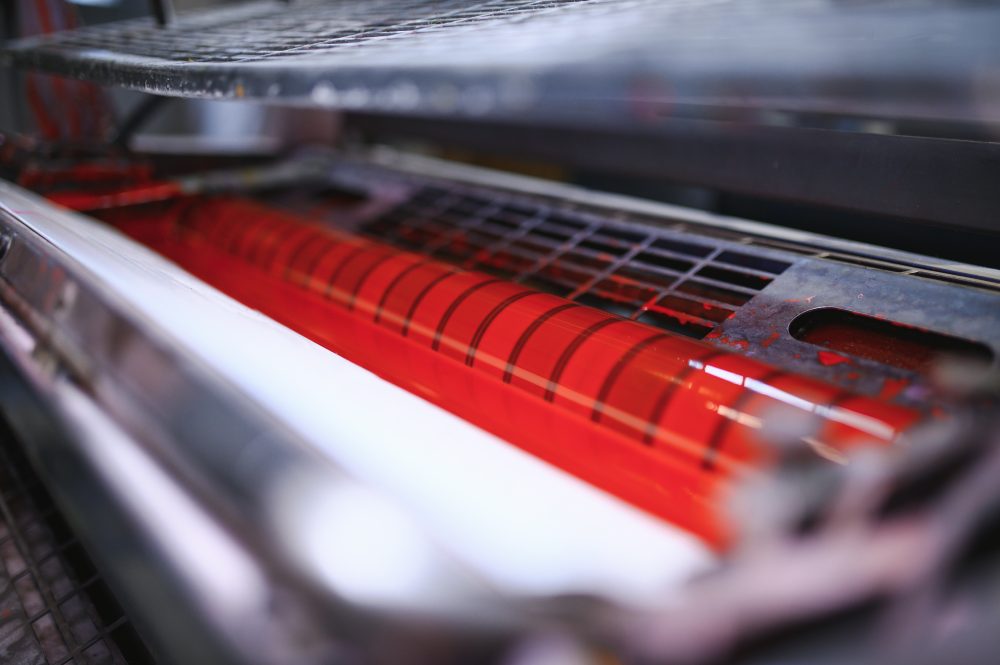
Why color drifts
Ink draw-downs, press sheets, labels and finished cartons can all carry the same nominal color and still measure differently. Paper whiteness, optical brighteners, ink film, coating, lamination and texture affect the result. Instrumented color control makes those variables visible before a run becomes waste.
Approve standards and production color with L*a*b*, spectral data and an agreed color-difference formula.
Track color at defined positions and intervals so drift is corrected while the press is still running.
Give printers, converters and brand owners one measurement method for approvals, claims and repeat orders.
Instrument options
Portable instruments suit press-side checks, incoming packaging and large finished items. Benchtop instruments suit controlled laboratory presentation, small specimens, transmission work and repeatable approval workflows.
Where it pays off
Approve brand colors against a protected physical and digital standard.
Reach the target faster by measuring early sheets before full production speed.
Sample defined positions across the web or sheet and trend drift through the run.
Check converted pieces after coating, lamination, embossing and finishing.
Verify supplier cartons, labels, closures and printed components before use.
Correlate instruments and exchange spectral data between brands, printers and converters.
Method notes
| Decision | Common starting point | Why it matters |
|---|---|---|
| Substrate | Measure the approved stock or control its whiteness and backing | Paper shade, opacity and brighteners can move both color and visual appearance. |
| Geometry | Keep geometry and specular condition fixed | Gloss, coatings and texture respond differently under different optical arrangements. |
| Aperture | Fit fully inside the printed patch | An aperture that includes unprinted stock, edges or adjacent colors produces a mixed result. |
| Tolerance | Name the formula and component limits | A shared ΔE number is only enforceable when every site calculates it the same way. |
UV control for paper and board
Many white papers and boards use optical brighteners. If they influence the approved appearance, define the UV condition and keep it consistent. The SD-700 UV is a relevant portable option where UV-included and UV-excluded comparison is required, but it is one option within the wider portable and benchtop ranges.
Specifying with confidence
Use the specimen that controls the commercial decision. Press sheets are best for process adjustment; the finished pack confirms the effect of coating, lamination, texture and conversion. Many programmes define both.
The substrate changes reflected light through its color, opacity, fluorescence and surface. Keep the approved stock fixed or define how substrate variation is handled.
It must fully cover the instrument’s true viewed and illuminated areas with margin for positioning. Confirm those areas for the selected aperture rather than relying only on the aperture name.
Yes, after agreeing the standard, sample construction, instrument geometry, settings, formula and correlation process. The limit alone is not a complete specification.
Related applications
Tell us the substrate, print process, patch size and tolerance. We’ll help match the geometry, aperture and workflow to the job.
UV Measurement
Understand how UV included, UV excluded and UV calibrated conditions affect optical brighteners, whiteness and agreement between spectrophotometers.
In-depth technical guide · Read the guide →Color Science
A whiteness index converts measured color data into a single application-specific value for near-white materials, but the formula, illuminant, observer and UV condition must match.
Quick technical guide · Read the guide →Measurement Techniques
Opacity and hiding power are assessed by comparing a controlled film or specimen over black and white backgrounds, with thickness and application held constant.
Quick technical guide · Read the guide →Measurement Techniques
A useful color standard combines an approved physical specimen, spectral target data, a defined measurement method and controlled storage and replacement rules.
Quick technical guide · Read the guide →Measurement Techniques
The master standard is the protected source of color authority; working standards are verified copies used for routine production decisions.
Quick technical guide · Read the guide →Buying & Selection
A supplier color specification should define the approved standard, measurement method, tolerance, sampling plan and actions for borderline or disputed results.
Quick technical guide · Read the guide →Fundamentals
Spectral data preserves how a sample interacts with each wavelength, enabling recalculation, metamerism analysis, color indices and deeper process diagnosis beyond one L*a*b* result.
Quick technical guide · Read the guide →Color Science
Reflectance measures light returned from a sample; transmittance measures light passing through it. The correct mode depends on the material and the quality question.
Quick technical guide · Read the guide →Measurement Techniques
Choose reading count from a documented sampling plan. Repeated readings, repositioned readings, locations and lots answer different questions.
Quick technical guide · Read the guide →Buying & Selection
Portable and benchtop describe form factor, not automatic optical capability, accuracy or software functionality. Choose by the measurement method.
Quick technical guide · Read the guide →Delta E
A defensible ΔE tolerance is tied to a product, approved standard and defined measurement method—not a universal number.
Quick technical guide · Read the guide →Troubleshooting
When two instruments differ, align the sample, settings and optical conditions before deciding there is an instrument problem.
Quick technical guide · Read the guide →