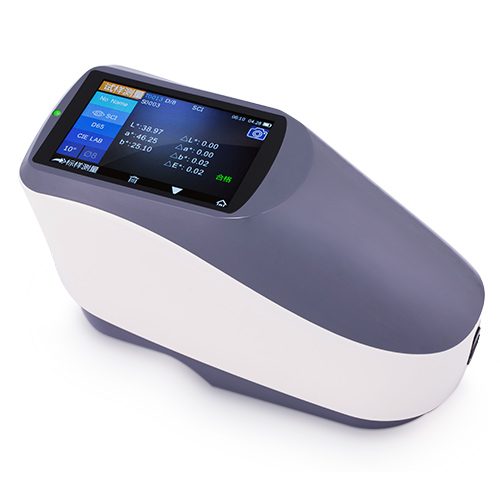
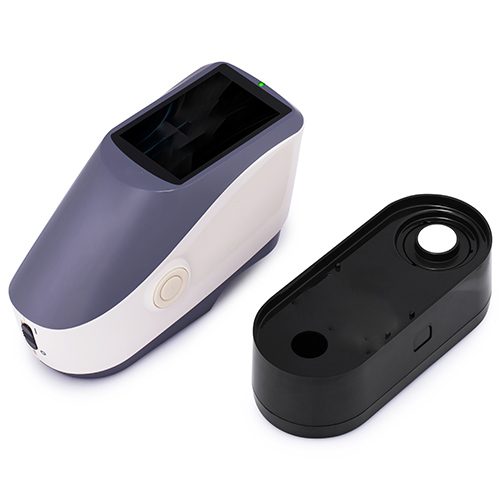
The SD-300 is a cost-effective portable grating spectrophotometer for professional color measurement, color matching and quality control. It combines d/8 optical geometry, SCI and SCE measurement, a 400–700 nm spectral range and a fixed 8 mm measurement aperture in a compact handheld instrument. A 3.5-inch capacitive touchscreen, camera-assisted positioning, onboard data storage, USB connectivity and PC software support make it a practical entry point for businesses that require repeatable spectral color measurement.
Key benefits
- Professional 400–700 nm spectral color measurement in a portable handheld instrument.
- d/8 optical geometry with SCI and SCE measurement.
- Fixed 8 mm measurement aperture suited to routine color-control applications.
- Repeatability specified at MAV/SCI ΔE* ≤ 0.06 under the manufacturer’s stated test condition.
- Inter-instrument error specified at MAV/SCI ΔE* ≤ 0.4.
- Camera-assisted positioning for accurate measurement placement.
- 3.5-inch capacitive TFT color touchscreen.
- USB connectivity.
- Storage for 800 standards and 20,000 sample measurements.
- Multiple color spaces, ΔE formulas, observers, illuminants and specialised colorimetric indices.
- Rechargeable portable design weighing approximately 600 g.
Built for reliable industrial color control
The SD-300 is designed for routine industrial color measurement where spectral data and objective color-difference assessment are required. Its concave-grating optical system measures spectral reflectance across the visible 400–700 nm range and calculates standard colorimetric values for color matching, sample comparison and production quality control.
Using diffuse illumination and 8° viewing geometry, the instrument supports both specular-component-included (SCI) and specular-component-excluded (SCE) measurement. This allows operators to assess intrinsic color while also accounting for the influence of surface gloss and texture where required.
The SD-300 uses a fixed 8 mm measurement aperture, making it particularly well suited to routine measurement of samples with sufficient flat measurement area. Camera-assisted positioning helps the operator accurately locate the measurement point, while the 3.5-inch capacitive color touchscreen displays spectral data, chromaticity values, color-difference results, PASS/FAIL assessment and color offset information.
With USB connectivity, substantial onboard sample storage and PC software support, the SD-300 provides a practical professional platform for transferring color data between quality-control, laboratory and production workflows.
SCI and SCE explained
SCI (specular component included) measurement includes the mirror-like reflection from the sample surface. It generally reduces the influence of gloss and texture differences on the reported color, which helps when the goal is to compare colorant or material color across variable finishes.
SCE (specular component excluded) measurement removes that surface reflection. It is more sensitive to surface finish and appearance, which is useful when gloss and texture are part of the color decision. Neither setting is a gloss-unit measurement, and the correct choice is the one named by your customer, product specification or validated internal method.
Fixed 8 mm measurement aperture
The SD-300 uses a single 8 mm measurement aperture with a 10 mm illumination aperture. This straightforward configuration suits routine measurements where the sample presents an adequate, consistent flat measurement area. If your workflow requires smaller or specialised measurement areas, the SD-500 offers configurable aperture options.
Applications
The SD-300 is intended for routine precision color measurement, color matching, color communication and production quality control. Typical workflows include comparing production samples against approved standards, incoming-material inspection, finished-product verification and recording objective color-difference data.
- Plastics and polymers
- Electronics
- Paints and coatings
- Printing inks
- Textiles and garments
- Printing and dyeing
- Paper and printed materials
- Automotive components and finishes
- Medical-related manufacturing
- Cosmetics
- Food and packaging
- Research institutes
- Universities, schools and laboratories
Technical specifications
| Model |
SD-300 |
| Optical geometry |
Reflectance: di:8°, de:8° — diffuse illumination, 8° viewing angle |
| Integrating sphere |
Φ48 mm |
| Light source |
Combined LED light source; no UV light source stated for the SD-300 |
| Spectrophotometric system |
Concave grating |
| Sensor |
256-element dual-array CMOS image sensor |
| Wavelength range |
400–700 nm |
| Wavelength interval |
10 nm |
| Spectral bandwidth |
10 nm |
| Measured reflectance range |
0–200% |
| Measurement aperture |
Single aperture: 8 mm measurement aperture / 10 mm illumination aperture |
| Specular component |
SCI and SCE |
| Color spaces |
CIE LAB, XYZ, Yxy, LCh, CIE LUV, s-RGB, HunterLab, βxy, DIN Lab99, Munsell (C/2) |
| Color-difference formulas |
ΔE*ab, ΔE*uv, ΔE*94, ΔE*cmc (2:1), ΔE*cmc (1:1), ΔE*00, DIN ΔE99, ΔE (Hunter) |
| Other colorimetric indices |
Spectral reflectance; whiteness indices; yellowness indices; metamerism index Mt; staining fastness; color fastness; dye/tinting strength; opacity; 8° gloss; 555 Index; blackness (My, dM); CMYK color density; Tint; Munsell. Manufacturer notes that some functions are realised through computer software. |
| Observer angle |
2° / 10° |
| Illuminants |
Multiple standard illuminants, including daylight, fluorescent and LED illuminants; available illuminant selection may depend on firmware or host software. Confirm the required illuminants for your application when ordering. |
| Displayed data |
Spectrogram / values; sample chromaticity values; color-difference values / graph; PASS/FAIL result; color offset |
| Measurement time |
2.6 seconds |
| Repeatability |
MAV/SCI: ΔE* ≤ 0.06 (manufacturer-stated) |
| Inter-instrument error |
MAV/SCI: ΔE* ≤ 0.4 (manufacturer-stated) |
| Measurement modes |
Single measurement; average measurement |
| Positioning |
Camera viewfinder positioning |
| Battery |
Rechargeable lithium-ion battery; manufacturer states 5,000 measurements within 8 hours |
| Dimensions |
184 × 77 × 105 mm (L × W × H) |
| Weight |
600 g |
| Light-source life |
5 years / more than 3 million measurements (manufacturer-stated) |
| Display |
3.5-inch TFT color LCD; capacitive touchscreen |
| Data interface |
USB |
| Data storage |
800 standard records; 20,000 sample records |
| Languages |
Simplified Chinese, Traditional Chinese, English, French, Portuguese, Russian, Spanish, Italian, German |
| Operating environment |
0–40 °C; 0–85% RH, non-condensing; altitude below 2,000 m |
| Storage environment |
−20–50 °C; 0–85% RH, non-condensing |
Included and optional accessories
Standard accessories: power adapter, built-in rechargeable lithium-ion battery, user guide, PC software, white and black calibration cavity / calibration components, and dust cover.
Optional accessories: micro printer, powder test box and multifunctional test component.
Manufacturer-referenced standards
The manufacturer states that the instrument conforms with or is designed with reference to CIE No. 15, GB/T 3978, GB 2893, GB/T 18833, ISO 7724-1, ASTM E1164 and DIN 5033 Part 7. These are manufacturer-stated claims; independent certification should be confirmed where required.
Frequently asked questions
What does the SD-300 measure?
It measures spectral reflectance across 400–700 nm and calculates colorimetric values and color differences for objective color comparison and quality control.
Does it support SCI and SCE?
Yes. The instrument supports both specular-component-included (SCI) and specular-component-excluded (SCE) measurement.
What aperture does it use?
The SD-300 uses a fixed 8 mm measurement aperture, with the manufacturer specification describing the aperture configuration as 8 mm measurement / 10 mm illumination.
Does it support UV measurement?
No UV source is specified for the SD-300. If UV measurement is required for fluorescent or optically brightened materials, the SD-700 provides LED and UV illumination.
Can measurements be transferred to a computer?
Yes. USB connectivity is supported, with PC software for color analysis and data handling.
How much data can it store?
The stated capacity is 800 standard records and 20,000 sample records.
Who is the SD-300 best suited to?
It is positioned as the straightforward, cost-effective model in the range for users who need professional spectral color measurement but do not require multiple aperture sizes or UV measurement.
Specifications are manufacturer-stated and may change without notice.